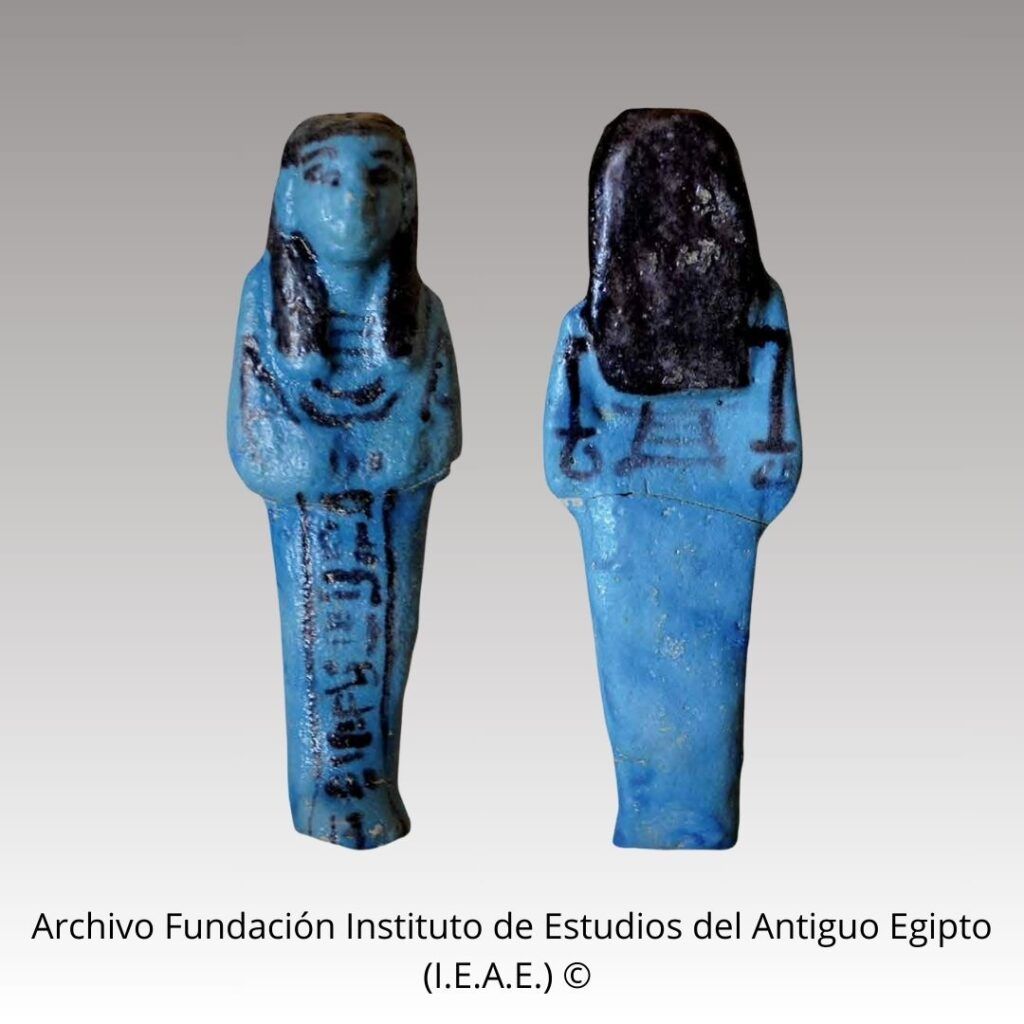
Ushebty Aj-Menu - Aj-Menu's Ushebty
1069-664 a.C / 1069-664 b.C.
Egipto / Egypt
Los ushebtys gozaron de gran popularidad entre los elementos a incluir en el ajuar funerario del Antiguo Egipto. De material y amaño variable, respondían por el fallecido en la otra vida del Más Allá desempeñando las tareas designadas.
Ushebtys were very popular among the elements to be included in the funerary trousseau of Ancient Egypt. Of variable material and size, they responded for the deceased in the afterlife of the Beyond by performing the designated tasks.
Detalles de la pieza /Artwork Details.
Este ushebty perteneció a un Sacerdote Uab del dios Amón, llamado Aj-Menu. Es de una fayenza de gran calidad, de color azul, que los especialistas llaman ‘azul Deir El Bahari’, típico de este lugar durante la Dinastía XXI, en el Tercer Periodo Intermedio.
Lleva peluca tripartita. En su parte frontal muestra los ojos pintados, un Collar Usej, una azuela en cada mano y sendas pulseras en cada una de las muñecas. Tiene una columna de texto, desde la parte inferior de los brazos hasta los pies, que dice: ‘El Osiris Uab de Amón, Aj-Menu, Justificado’. En la espalda se distinguen claramente pintados en negro un ‘yugo de hombro’ o percha del que penden dos vasijas para transportar agua, y la bolsa de semillas, instrumentos típicos representados en los ushebtys de este periodo.
This ushebty belonged to a Uab priest of the god Amun, called Akh-Menu. It is made of faience of great quality, blue color, that the specialists call ‘Deir El Bahari blue’, typical of this place during XXIth Dynasty, in the Third Intermediate Period.
It wears a tripartite wig. On its frontal part it shows the painted eyes, a Usekh necklace, an hoe in each hand and bracelets in each one of the wrists. It shows a column of text, from the lower part of their arms to the feet, which says: ‘The Osiris Uab of Amun, Akh-Menu, Justified’. On the back are clearly painted in black a ‘shoulder yoke’ or perch from which hang two vessels to transport water and the bag of seeds, typical instruments represented in the ushebtys of this period.
Ficha técnica / Overview:
Campaña / Season: 2016.
Título / Title: Ushebty de Aj-Menu /Aj-Menu’s ushebty
Periodo / Period: Tercer Periodo Intermedio 1069-664a.C. /Third Intermediate Period 1069-664 b.C.
Cronología / Chronology: XXI Dinastía 1069 – 664 a.C. / XXI Dynasty 1069 – 664 b.C.
Procedencia / Origin: Tumba del Visir Amen-Hotep Huy AT-28-. Localizado en el area del Patio, zona norte. Asasif. Luxor West Bank.
Actualidad / Present : Luxor Museum.
Materia/ Materials: Fayenza y decoraciones negras / Faience and black decorations.
Dimensiones: 11,8 cm. x 3,98 cm. x 2,42 cm.
Nº Registro: 10362-16.
Bibliografía / Bibliography:
- Bedman, T. Martín-Valentín, F y El Menshawy, A. (Eds.): Los Tesoros del Visir Amen-Hotep Huy. Catálogo de la Exposición, El Cairo, 2021.
- Martín Valentín, F. y Bedman, T (Ed.): Proyecto Visir Amen-Hotep Huy (Tumba AT-28-).Memoria preliminar 2009-2016. Misión Arqueológica española en Asasif (Luxor-Occidental). Málaga, 2017.
- Shaw, I. : Historia del Antiguo Egipto. Madrid. 626-627.
POR: Teresa Bedman, Mario Calvo, María Galvín, y Florencia Nicolari.