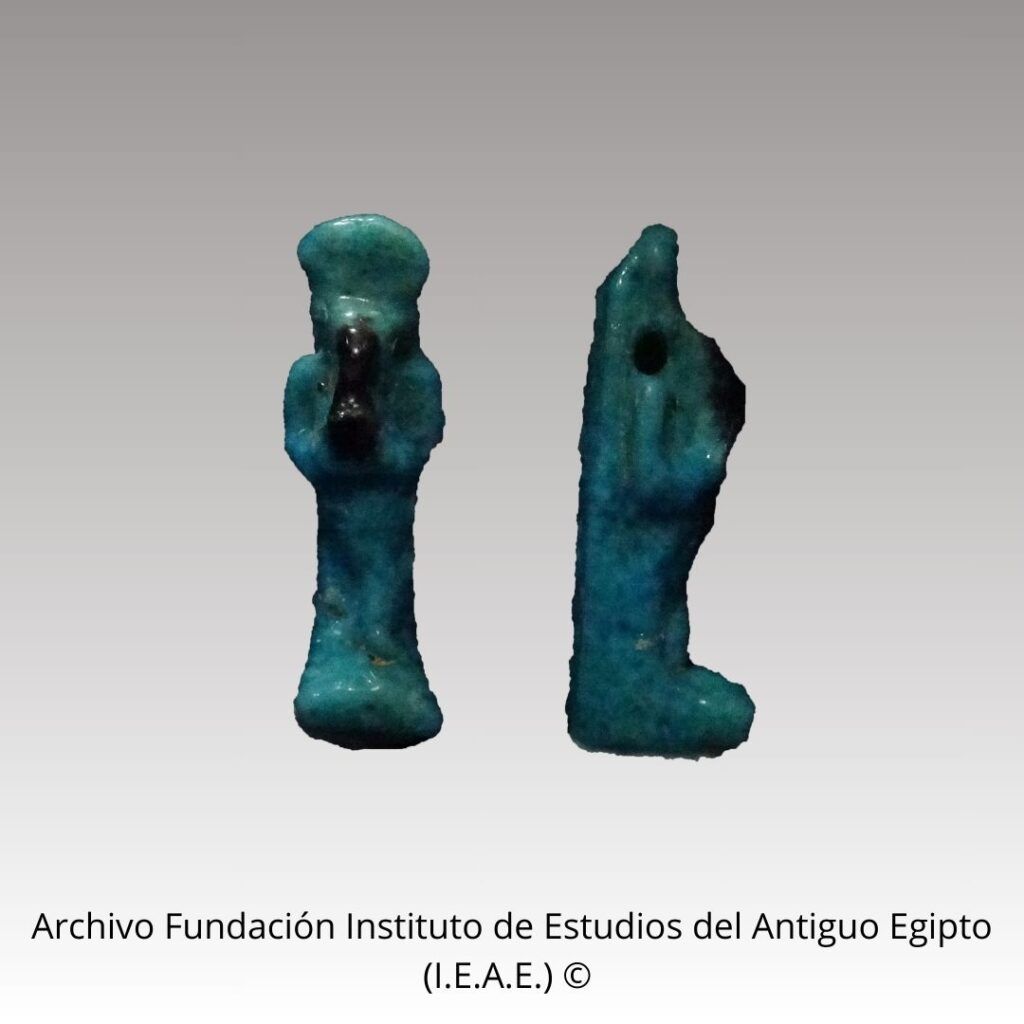
Amuleto de la Diosa Tefnut - Amulet of the Goddess Tefnut.
664-332 a.C/ 664-332 b.C
Egipto/ Egypt
Tefnut era la diosa egipcia de la humedad, que junto a su esposo, el dios del aire Shu, encarnaban el orden cósmico. Representada como una mujer con cabeza de leona, se la asociaba con la energía solar y era considerada la «Ojo de Ra» en su aspecto feroz y guerrero. Era parte de la primera pareja de dioses creada por Atum, y junto con Shu, fueron padres de Geb (la Tierra) y Nut (el Cielo).
Representa la humedad vital, el rocío y la lluvia provoca la fertilidad a la tierra.
En su aspecto más leonino, era el Ojo de Ra, una fuerza destructiva que podía aniquilar todo y hasta causar sequías. Se la representaba como una leona o una mujer con cabeza de leona, simbolizando su poder, valentía y naturaleza protectora. Tambien era una diosa madre, formando la primera pareja divina con Shu, y siendo madre de los dioses Geb (tierra) y Nut (cielo). Por lo tanto era una parte esencial del equilibrio cósmico, y junto a Shu, mantenía el orden en el universo, el aire y la tierra.
Como amuleto protector, se utilizaba para simbolizar el poder de la creación del ‘Primer Día’.
Tefnut was the Egyptian goddess of moisture, who, along with her husband, the air god Shu, embodied cosmic order. Depicted as a woman with the head of a lioness, she was associated with solar energy and was considered the «Eye of Ra» in her fierce and warlike aspect. She was part of the first pair of gods created by Atum, and together with Shu, they were the parents of Geb (the Earth) and Nut (the Sky).
She represents vital moisture; dew and rain bring fertility to the earth.
In her most leonine aspect, she was the Eye of Ra, a destructive force that could annihilate everything and even cause droughts. She was depicted as a lioness or a woman with the head of a lioness, symbolizing her power, courage, and protective nature. She was also a mother goddess, forming the first divine couple with Shu, and being the mother of the gods Geb (earth) and Nut (sky). Therefore, he was an essential part of the cosmic balance, and together with Shu, he maintained order in the universe, the air, and the earth.
As a protective amulet, it was used to symbolize the power of creation of the ‘First Day’.
Detalles de la pieza / Artwork Details:
Este amuleto esta realizado en fayenza y aunque es un poco tosco, la pasta es de buena calidad. Presenta un orificio a la altura de la cabeza de la leona, por lo que hemos de pensar que estaba o bien cosido a la vendas de la momia o engarzado a alguna pulsera o collar.
Se aprecia el disco solar sobre la cabeza de la diosa asi como sus brazos.
This amulet is made of faience, and although it is somewhat rough, the material is of good quality. It has a hole at the level of the lioness’s head, so we must assume that it was either sewn onto the mummy’s wrappings or attached to a bracelet or necklace.
The solar disk is visible above the goddess’s head, as are her arms.
Ficha técnica / Overview:
Título: / Title: Amuleto de la Diosa Tefnut/ Tefnut amulet
Periodo /Period: Baja Época 664-332 a.C / . Late Period 664-332 b.C.
Cronología / Chronology: Dinastía 664 a.C.- 332 a.C./ XXVI Dynasty 664 a.C.- 332 b.C.
Procedencia / Origin: Tumba del Visir Amen-Hotep Huy AT-28-. Patio norte. Asasif. Luxor West Bank.
Actualidad / Present : Luxor Museum.
Materia/ Materials: Fayenza / Faience.
Dimensiones: 2,6 cm. x 1 cm.
Nº Registro: 10349-16
Bibliografía / Bibliography:
- Andrews, C.:Amulets of Ancient Egypt. British Museum, 1994.
- Bedman, T. Martín-Valentín, F y El Menshawy, A. (Eds.): Los Tesoros del Visir Amen-Hotep Huy. Catálogo de la Exposición, El Cairo, 2021.
- Martín Valentín, F. J.: Los magos del Antiguo Egipto. Madrid, 2002.
- Martín Valentín, F. J. : Azules Egipcios. Pequeños tesoros del Arte: Los dioses y las cosmogonías. Barcelona, 2005 págs. 23-27.
- Martín Valentín, F. y Bedman, T (Ed.): Proyecto Visir Amen-Hotep Huy (Tumba AT-28-).Memoria preliminar 2009-2016. Misión Arqueológica española en Asasif (Luxor-Occidental). Málaga, 2017.
- Shaw, I.: Historia del Antiguo Egipto. Madrid, 2007.
Por: Teresa Bedman, Mario Calvo, Javier Chamorro, María Galvín, y Florencia Nicolari.