1069-664 a.C / 1069-664 b.C
Egipto / Egypt.
El Ojo Udyat,  también conocido como el Ojo de Horus, constituye uno de los amuletos más emblemáticos y ampliamente utilizados en el Antiguo Egipto. Su nombre proviene del término egipcio “wedjat”, que significa “el que está completo” o “el restaurado”, en referencia a su origen mitológico y a sus asociaciones con la protección, la salud y la integridad espiritual.El Ojo Udyat tiene su raíz en la mitología osiríaca. Según los textos religiosos, Horus, dios celeste y símbolo del orden, perdió su ojo izquierdo durante un combate contra Seth, dios del caos, en venganza por la muerte de su padre, Osiris. El ojo fue posteriormente sanado y restituido por el dios Thot, asociado con la sabiduría y la medicina. Este acto de restauración convirtió el ojo en un símbolo de curación, equilibrio y plenitud.Desde un punto de vista iconográfico, el Ojo Udyat es una estilización del ojo humano, que incluye elementos simbólicos como la línea curvada debajo del ojo (representando una marca de halcón) y una espiral que alude a la lágrima. El ojo izquierdo, vinculado con la luna, representa la intuición, lo oculto y la percepción emocional, en contraste con el ojo derecho, asociado con Ra, el sol y la razón. Como amuleto, el Ojo Udyat fue ampliamente utilizado desde el Imperio Antiguo hasta el período romano. Se empleaba en contextos funerarios, colocándose entre las vendas de las momias para proteger al difunto en el Más Allá. También era llevado por los vivos como colgante, tallado en piedras semipreciosas como lapislázuli, cornalina o turquesa, con el fin de brindar protección contra enfermedades, accidentes y fuerzas malignas.
The Udjat Eye, also known as the Eye of Horus, is one of the most iconic and widely used amulets in Ancient Egypt. Its name comes from the Egyptian term «wedjat,» meaning «the one who is whole» or «the restored one,» in reference to its mythological origin and its associations with protection, health, and spiritual integrity. The Udjat Eye has its roots in Osirian mythology. According to religious texts, Horus, the sky god and symbol of order, lost his left eye during a battle against Seth, the god of chaos, in revenge for the death of his father, Osiris. The eye was later healed and restored by the god Thoth, associated with wisdom and medicine. This act of restoration turned the eye into a symbol of healing, balance, and wholeness. From an iconographic point of view, the Udjat Eye is a stylization of the human eye, which includes symbolic elements such as the curved line below the eye (representing a falcon’s mark) and a spiral alluding to a teardrop. The left eye, linked to the moon, represents intuition, the occult, and emotional perception, in contrast to the right eye, associated with Ra, the sun, and reason. As an amulet, the Udjat Eye was widely used from the Old Kingdom to the Roman period. It was used in funerary contexts, placed between the bandages of mummies to protect the deceased in the Afterlife. It was also worn by the living as a pendant, carved from semiprecious stones such as lapis lazuli, carnelian, or turquoise, to provide protection against illness, accidents, and evil forces.
Detalles de la pieza / Artwork Details:
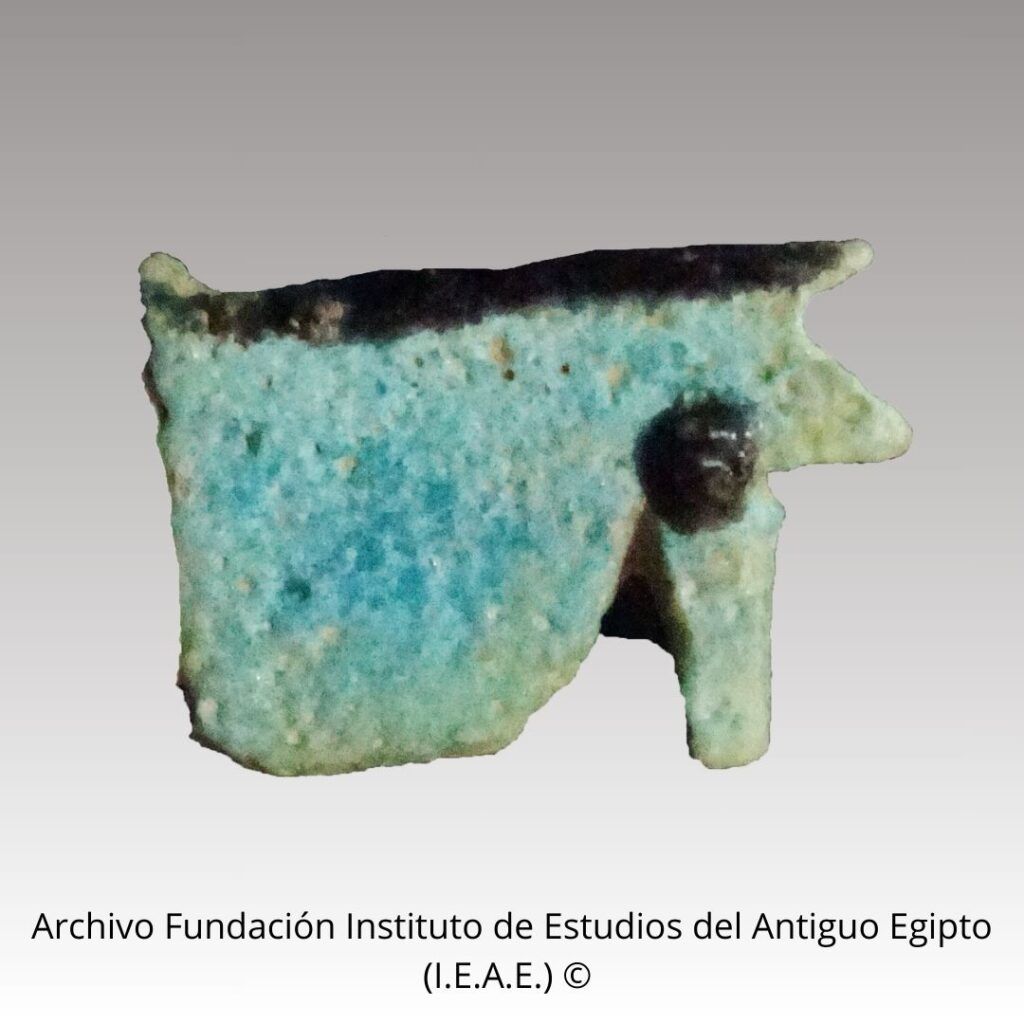
Este amuleto con forma de Ojo Udjat , parece que formó parte de un colgante. Está perforado de estremo a estremo por el que presuponemos llevaría un cordón o hilos para portarlo. Representa el ojo derecho, por lo que estaría representando al sol, asociado con el dios Ra. La ceja esta remarcada en negro asi como el iris del ojo.
This amulet, shaped like the Udjat Eye, appears to have been part of a pendant. It is pierced from end to end, which we assume would have had a cord or thread for carrying it. It represents the left eye, so it would represent the moon. The eyebrow is highlighted in black, as is the iris of the eye.