
Concubina funeraria de marfil - Ivory funerary concubine
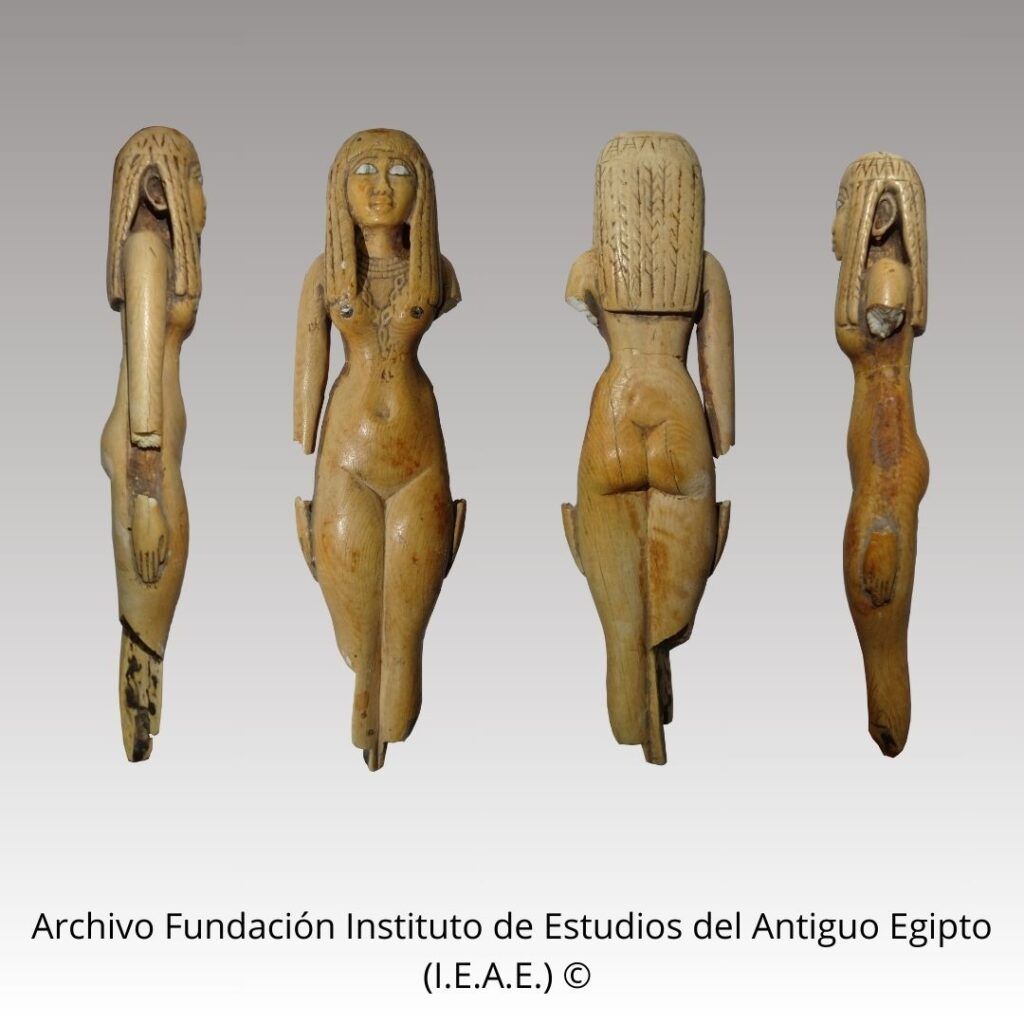
1099-945 a.C. / Circa 1099-945 b.C.
Egipto/ Egypt.
Las concubinas funerarias eran pequeñas figuras que servían para ofrecer servicios de carácter sexual en el más allá al difunto.
Funerary concubines were small figures that served to offer sexual services in the afterlife to the deceased.
Detalles de la pieza / Artwork Details:
Talla en marfil.
La figura lleva una peluca tripartita, con pequeñas trenzas terminadas en bucles.
Su frente, está decorada con una diadema vegetal de capullos de nenúfar. Tiene las orejas perforadas con agujeros para pendientes o zarcillos que bien hubieran podido ser de oro. Su cuello, está adornado por un collar Usej de cuentas con tres vueltas, del que pende una cadeneta formada por conchas de cauries que termina con un colgante con la efigie de un gato probablemente la diosa Bastet.
En el lugar donde fue localizada dicha concubina, también se localizaron conchas de cauri, lo que en opinión del Dr. Francisco Martín-Valentín y Teresa Bedman, la concubina llevaría físicamente , alrededor de su cuello o junto a ella, un collar de dichas conchas con la pequeña gata, que hubiera podido ser de oro, y que fue del interés de los ladrones, desechando las conchitas.
Es muy posible que esta pequeña estatua estuviera insertada en algún pedestal o similar, dada la posición de sus piernas juntas así como la de sus brazos, que estan pegadas al cuerpo, lo que la da un momento estático de eternidad.
En la actualidad, dicha concubina, se exhibe en el Museo Egipcio de Luxor con sus conchitas.
El término «cauri»es el nombre común de un grupo de caracolas marinas pequeñas y grandes, moluscos gasterópodos marinos de la familia Cypraeidae.
Las pequeñas conchas que porta nuestra concubina, seguramente proceden del Mar Rojo, y eran muy valoradas como amuletos. Se cree que, su parecido con la vulva femenina, y también con un ojo, las asociaba con la fertilidad y la protección contra el mal de ojo. Normalmente se localizan siempre en enterramientos femeninos, raramente se ha localizado en enterramientos masculinos.
Carved in ivory.
The figure wears a tripartite wig with small braids ending in curls.
Her forehead is decorated with a vegetal diadem of water lily buds. Her ears are pierced with holes for earrings, which could well have been made of gold. Her neck is adorned with a Usej necklace of beads with three strands, from which hangs a chain made of cowrie shells ending in a pendant with the effigy of a cat, probably the goddess Bastet.
At the site where this concubine was found, cowrie shells were also discovered. According to Dr. Francisco Martín-Valentín and Teresa Bedman, this suggests that the concubine would have physically worn, around her neck or next to her, a necklace of these shells with the small cat, which could have been made of gold, and which was of interest to the thieves, who discarded the shells.
It is quite possible that this small statue was mounted on a pedestal or similar structure, given the position of her legs together and her arms, which are close to her body, creating a static, timeless pose.
Currently, this concubine is on display at the Egyptian Museum in Luxor, along with her cowrie shells.
The term «cowrie» is the common name for a group of small and large marine snails, gastropod mollusks of the family Cypraeidae.
The small shells carried by our concubine likely originated in the Red Sea and were highly valued as amulets. It is believed that their resemblance to the female vulva, and also to an eye, associated them with fertility and protection against the evil eye. They are typically found in female burials and rarely in male burials.
Ficha técnica / Overview:
Campaña / Season: 2009.
Título / Title: Concubina funeraria / Funeral concubine
Periodo / Period: Periodo Ramésida tardío a Tercer Periodo Intermedio 1099-945 a.C. / Late Ramesside to Third Intermediate Period 1099-945 b.C.
Cronología / Cronología: Reino Ramsés XI a XXI Dinastía 1099-945 a.C. / Ramsés XI a XXI Dinastía 1099-945 b.C.
Procedencia / Origin: Lúxor. Tumba del Visir Amen-Hotep Huy AT-28-. Asasif. Luxor West Bank.
Actualidad: Luxor Museum.
Material / Materials: Talla de marfil./ Carved ivory.
Dimensiones: 13,04 cm. x 3,02 cm. x 1,04 cm.
Nº Registro: 514-09.
Bibliografía / Bibliography:
- Bedman, T. Martín-Valentín, F y El Menshawy, A. (Eds.): Los Tesoros del Visir Amen-Hotep Huy. Catálogo de la Exposición, El Cairo, 2021.
- Martín-Valentín F & Bedman, T, Eds: Visir Amen-Hotep Huy (Tumba AT-28-). Misión Arqueológica Española en Asasif (Luxor occidental). Memoria Preliminar: Campañas 2009-2016. Málaga, 2017.
- Shaw, I. Historia del Antiguo Egipto. La esfera de los libros, Madrid, 2007, págs. 626-627.
Por: Teresa Bedman, Mario Calvo, Javier Chamorro, María Galvín, y Florencia Nicolari.