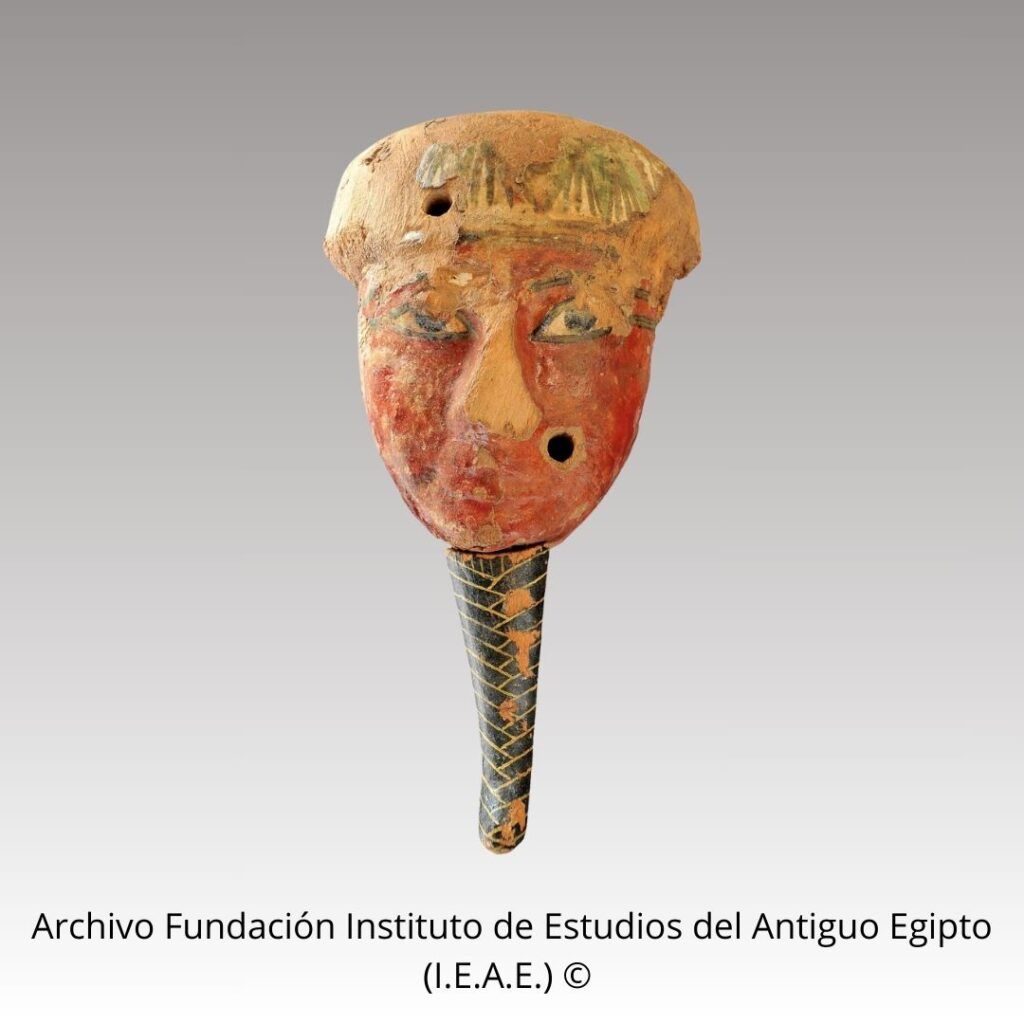
Máscara de Sarcófago de Pa-Di-(Iry)Jonsu / Coffin Mask Pa-DI-(Iry)-KHonsu.
1069-664 a.C / 1069-664 b.C.
Egipto / Egypt
Los sarcófagos del Antiguo Egipto tenían una morfología antropomorfa muy característica que sujeta a las tendencias de cada periodo, por ello podemos apreciar variaciones artísticas pero con patrones comunes.
The sarcophagus of Ancient Egypt had a very characteristic anthropomorphic morphology that was subject to the trends of each period, which is why we can see artistic variations but with common patterns.
Detalles de la pieza / Artwork Details:
Mascara sarcófago con barba, de madera policromada.
Como detalles ornamentales característicos se incluyen motivos vegetales en forma de corona sobre la peluca. Presenta dos orificios de origen desconocido, uno en la parte superior derecha de la cabeza y otro en el rostro, en la zona del surco nasogeniano izquierdo. Entre la técnica pictórica, se aprecia la aplicación de estuco a modo de capa de preparación y el buen estado de conservación de los pigmentos aplicados a modo de policromía. La calidad de dicha máscara, nos habla de un personaje de alto estatus social. Y dado que alrededor de dicha máscara localizamos en la campaña del 2012, objetos también de muy alta calidad junto con numerosos ushebtis que llevaban el nombre de Pa-Di-(Iry)-Jonsu, proponemos que dicha máscara sea la suya.
Las investigaciones sobre este personaje, hemos descubrimos que, Pa-di-Iry-Jonsu había pertenecido a una ilustre familia. Su padre, llamado Anj-ef-(en)-Jonsu, descendía de un Segundo Profeta de Amón, llamado Ra-Ma, , su título “Padre divino, amado del dios, el que abre las Puertas del Cielo en Ipet-Sut”, lo que quería decir que tuvo acceso directo al “santo de los santos” del templo y participó en el rito del culto divino diario para el dios en Karnak.
Su madre, llevó los títulos de Cantora de Amon-Re y Señora de la Casa, Dyed-Mut-Iu-es-Anj. Era hija de Anjef-(en)-Jonsu y descendía del Cuarto Profeta de Amón Najt-ef-Mut. Esta mujer a su vez, se desposo con Ra-Ma como hemos mencionado anteriormente y tuvo al menos tres hijos:
-
- Pa-di-Iry-Jonsu
- Anj-ef-(en)-Jonsu
- Hory.
El sarcófago de Dyed-Mut-Iu-es-Anj, actualmente se encuentra en los Museos Vaticanos.
La tumba intacta del segundo hermano, Anj-ef-(en)-Jonsu, fue localizado tambien en el patio solar de la capilla del Visir Amen-Hotep Huy, por el equipo de la Fundación del Instituto de Estudios del Antiguo Egipto en Diciembre del 2015 ( nº inventario 10176-15).
Sarcophagus mask with a beard, made of polychrome wood.
Characteristic ornamental details include vegetal motifs in the form of a crown above the wig. It has two holes of unknown origin, one in the upper right part of the head and the other on the face, in the area of the left nasolabial fold. The painting technique reveals the application of stucco as a preparatory layer and the good state of preservation of the pigments applied as polychromy. The quality of this mask suggests a person of high social status. And given that, during the 2012 excavation, we found other objects of very high quality around this mask, along with numerous ushabtis bearing the name Pa-Di-(Iry)-Khonsu, we propose that this mask is his.
Research on this individual has revealed that Pa-di-Iry-Khonsu belonged to an illustrious family. His father, named Ankhef-(en)-Khonsu, was descended from a Second Prophet of Amun, named Ra-Ma, whose title was «Divine Father, beloved of the god, he who opens the Gates of Heaven in Ipet-Sut,» meaning he had direct access to the «holy of holies» of the temple and participated in the daily divine worship ritual for the god at Karnak.
His mother bore the titles of Singer of Amun-Re and Lady of the House, Djed-Mut-Iu-es-Ankh. She was the daughter of Ankhef-(en)-Khonsu and descended from the Fourth Prophet of Amun, Nakhtef-Mut. This woman, in turn, married Ra-Ma, as mentioned previously, and had at least three sons:
-
- Padi-Iry-Khonsu
- Ankhef-(en)-Khonsu
- Hory
The sarcophagus of Djed-Mut-Iu-es-Anj is currently in the Vatican Museums.
The intact tomb of the second brother, Anj-ef-(en)-Khonsu, was also located in the courtyard of the chapel of Vizier Amenhotep Huy by the team from the Foundation of the Institute of Ancient Egyptian Studies in December 2015 (inventory no. 10176-15).
Ficha técnica / Overview:
Campaña / Season: 2018.
Título / Title: Set de ushebtis / Ushebties set.
Periodo / Period: Tercer Periodo Intermedio 1069-664a.C./ Third Intermediate Period 1069-664 b.C.
Cronología / Chronology: XXI Dinastía 1069 – 664 a.C./ XXI Dynasty 1069 – 664 b.C.
Procedencia / Origin: Lúxor. Tumba del Visir Amen-Hotep Huy AT-28- B/C. Asasif. Luxor West Bank.
Actualidad / Present : Luxor Museum.
Materia/ Materials: Madera, estucada y pintada. l Wood, stuccoed and painted.
Dimensiones: 21,6 cm x 19,9 cm x 7,2 cm.
Nº Registro: 6111-12
Bibliografía / Bibliography:
- Bedman, T. y Martín-Valentín F. La Tumba del Escriba de Amón, Profecía Cumplida. La Aventura de la Historia, nº 210. Madrid, págs. 50-54.
- Bedman, T. Martín-Valentín, F y El Menshawy, A. (Eds.): Los Tesoros del Visir Amen-Hotep Huy. Catálogo de la Exposición, El Cairo, 2021.
- Martín Valentín, F. Azules Egipcios. Pequeños tesoros del Arte: Los dioses y las cosmogonías. Barcelona,2005, págs. 23-27.
- Martín Valentín, F. y Bedman, T (Ed.): Proyecto Visir Amen-Hotep Huy (Tumba AT-28-).Memoria preliminar 2009-2016. Misión Arqueológica española en Asasif (Luxor-Occidental). Málaga, 2017.
- Shaw, I. : Historia del Antiguo Egipto. Madrid, 2007, págs. 626-627.
Por: Teresa Bedman, Mario Calvo, Javier Chamorro, María Galvín, y Florencia Nicolari.